
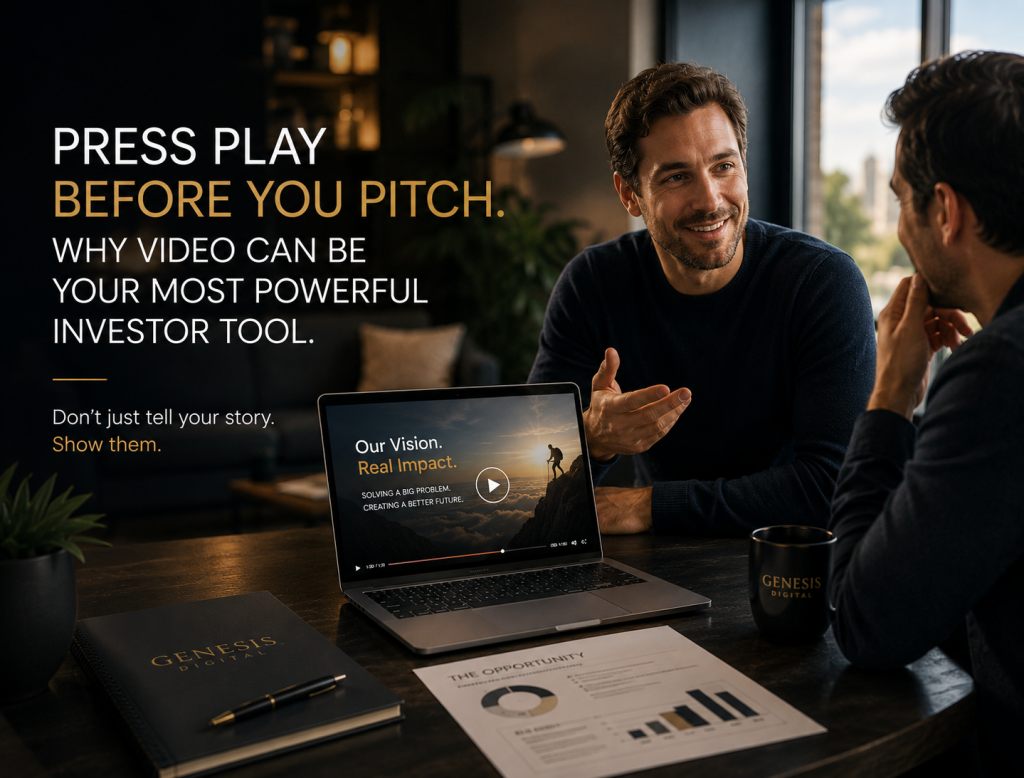
Some products make perfect sense the moment you see them.
That is why a founder can spend five minutes explaining a device, platform or technology and still get a polite, slightly confused nod—then show a 30-second animation and hear, “Oh. Now I get it.”
That moment is exactly why video can be so useful in an investor conversation.
An investor video is not a commercial with dramatic music and a collection of words like innovative, disruptive and revolutionary. Investors have heard those words before breakfast. The video has a more practical job: help someone understand the problem, the solution and the opportunity quickly.
For a medical device, animation can show what is happening inside the body. For a physical product, 3D visualization can reveal how it works before full-scale production. For software, motion can make a workflow understandable without forcing someone to study a screen full of tiny interface elements.
The advantage is not simply that video looks impressive. It combines explanation, demonstration, emotion and pacing. A founder can say, “This process is complicated.” A video can let the investor see the complication and then watch the solution simplify it.
Video has also become a normal part of business communication. Wistia’s State of Video research is based on analysis of 13 million videos, reflecting how deeply video is now embedded in the way companies explain products, educate audiences and communicate online.
For investor use, shorter is usually better. A strong 60- to 90-second piece can create context before the deeper presentation begins. It can also work after the meeting, when the investor forwards the opportunity to someone who was not there.
That second life is important. A well-designed investor video can live on a website, support outreach, accompany a deck, help explain the company to strategic partners and provide material for shorter digital content. One asset can do a surprising amount of work.
Of course, video is not automatically better than slides. In fact, Y Combinator cautions founders to think carefully before adding video or screencasts to a short pitch because anything that distracts from the core idea can work against you. The lesson is not “use video everywhere.” It is “use video when it makes the idea clearer.”
At Genesis Digital, we approach investor video from the story first. What is difficult to understand? What should the investor feel? What can we show more effectively than we can explain? Then filmmaking, animation, graphics, product visualization and voiceover become tools rather than decoration.
If seeing it makes the opportunity click, do not spend ten slides asking the investor to imagine it.